Housing for Beef Cattle Square Footage in Pasture
Quick facts
Compost dairy barns can be a good housing organisation for lactating dairy cows. The following are keys to success in compost barns:
- Provide at least 100 square feet per Holstein cow and similar size breeds. Jerseys need 85 square anxiety per cow.
- Use fine, dry wood shavings or sawdust for bedding. Other fine and absorbent materials such every bit chopped soybean straw or flax chives can work.
- Add bedding when it begins to stick to the cows. Bedding should exist less than 65% moisture.
- Aerate the pack twice daily, 10 inches deep or deeper, to add oxygen and keep it fluffy.
- Ventilate the barn well to remove the moisture.
- Use first-class cow prep at milking time.
What is a compost dairy barn?
Compost-bedded pack barns (compost dairy barns) are an alternative loose housing organization for dairy cows. They appear to offer practiced comfort for lactating, dry out and special needs cows.
In general, compost barns have
-
Indoor or outdoor concrete feed aisle
-
Bedded pack (resting) area
-
A iv-foot-high wall surrounding the pack
-
Contains one to four walkways for cows and equipment to access the pack
-
Usually made of poured concrete
-
A compost barn gives cows more room to movement than tie stalls or free stalls. These barns may also reduce manure storage costs and space, and save in labor and manure handling.
Compost barns aren't ideal for every dairy producer. For success, always match the manager with the system.
Befouled layout
There's 1 fundamental deviation between compost dairy barns and freestall dairy barns. Instead of gratuitous stalls and freestall alleys, compost dairy barns have a bedded pack area that'due south aerated twice daily.
You can lay out compost barns for different feeding practices including:
-
Drive-by feeding (meet figure 1)
-
Covered feeding
-
Bulldoze-through feeding with pens on both sides
-
Bunk feeding (within or exterior)
|
A 4-foot (1.2 m) high wall borders the pack on iii sides and separates information technology from the feed alley.
The two outside walls tin exist bandage-in-place concrete walls on footings below normal frost depths or woods. You tin can take the posts support the roof embedded in the outside walls or take the posts mounted on top of the wall. Make certain the structural engineer or the builder sympathise all structural loads including:
-
Manure load
-
Lateral globe pressure
-
Car load
-
Roof load
-
Wind load
-
Wind lift load
-
Snowfall load
-
Others
The wall separating the pack area and the feed alley can be bandage-in-identify concrete or moveable, wide-based concrete panels, called Jersey walls. A fence on top of this wall can prevent cows from walking over it.
Walkways, at to the lowest degree ten to 12 feet wide, provide cows and equipment access to the pack surface area. At minimum there should exist a walkway at each end of the wall separating the pack and the feed alley. Long barns volition need more walkways.
Locate waterers along the feed alley. Yous can place waterers on either side of the feed manger or side by side to the concrete wall separating the pack and the feed aisle. Avoid placing waterers in the bedded pack area to:
-
Reduce wetting of the pack.
-
Keep the waterers cleaner.
-
Avert having to conform waterer height equally pack depth increases.
Compost barns should have 3-foot eave overhangs to aid foreclose roof runoff and rain from blowing in. Roof gutters will also help keep roof runoff out. Slope the ground around a compost barn to reduce snowfall and rain runoff from entering the barn.
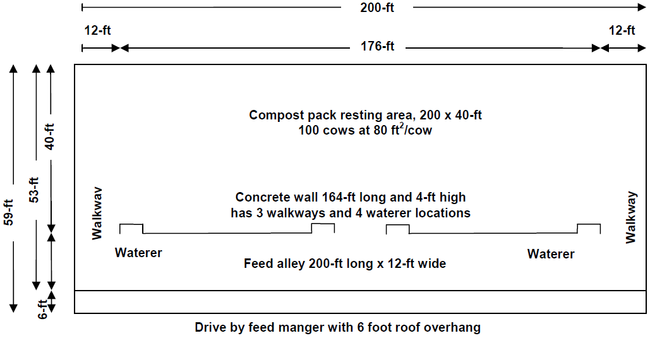
-
Three walkways to access the pack
-
Drive-by feeding
-
A half dozen-foot overhang
Waterers are against the concrete wall separating the bedded pack from the feed alley. Cows can only access them from the feed alley.
Managing the packed bedding
Compost barn pens first with a 1- to ane.5-foot layer of loose, dry fine wood shavings or sawdust. Add fresh bedding when the pack gets moist plenty to stick to the cows after they lie down on it. The bedded area should provide 100 feet per moo-cow of resting space.
|
Aerate the bedding to a depth of 8 to 10 inches twice daily during milking. A modified cultivator on a slip loader or small-scale tractor works well.
Aeration brings in oxygen, which may help aerobic breakdown of the bedding. It also provides a fresh surface with less manure for cows to lie downwards on later on returning from milking or feeding. Some Minnesota producers aerate the pack deeper (about 16 to eighteen inches) with a chisel-plough blazon of equipment. Equally a result, these producers didn't need as much bedding and had increased
Typically, producers demand to add a semi-truck load of fresh dry sawdust (approximately xviii tons) every two to five weeks. This corporeality will change based on the post-obit.
-
Flavor
-
Weather
-
The number of cows
Some dairies may add smaller amounts of sawdust more often, such as one time weekly. A small number of other dairies add a thin layer of bedding every twenty-four hour period.
Usually, producers only remove bedding cloth from the pack area in the fall and spring. You only need to entirely clean out the pack expanse yearly in September or October.
After removing soiled bedding, producers usually add a load of clean sawdust. This sawdust provides a bedding layer i to 1.v anxiety high to start the new pack. Most producers exit virtually 0.5 feet of old fabric in the barn to assistance commencement microbial activeness.
By the end of summer, most packs average 4 feet high. Farms may remove some of the pack cloth in the spring to provide space for added bedding during the summer.
Producers spread soiled bedding on the fields according to their manure management plan. Others may pile soiled bedding to produce finished compost.
Ventilation
Compost dairy barns demand good ventilation (air commutation) to:
-
Remove cow wet and heat.
-
Remove pack wet and heat from microbial action.
-
Remove moisture and extend the time betwixt bedding additions in the winter.
High wet commonly appears as steam rising from the pack during aerating in cold weather. This moisture needs to leave the befouled with the ventilation air.
Compost barns should have xvi-human foot sidewalls for better ventilation. This peak besides provides access for bedding trucks. The college sidewall meridian in a compost barn, compared to a freestall barn, accommodates the sidewall opening lost from the pack walls.
Many compost barns accept mixing fans to accident air downwardly onto the pack, which helps dry out the surface. Hang the fans high enough to provide caput room for aerating equipment at the top pack-height.
Fertilizer value and pack temperatures
In a cross-sectional study we took samples of the pack at ii depths. Nosotros analyzed these bedding samples for the following.
-
Moisture
-
Ammonia
-
pH
-
Total Carbon (C)
-
Nitrogen (N)
-
Phosphorus (P)
-
Potassium (1000)
-
Electrical conductance (soluble salts) concentrations
Tabular array one shows the results, which includes a cavalcade with recommended values for composting.
The average carbon to nitrogen (C:Northward) ratio was xix.5:1. A C:N ratio below 25:1 may give off ammonia olfactory property, which may influence the ammonia levels in compost barns.
The average bedding temperature was 108 F. The pack surface temperatures were similar to the surrounding temperature. Temperatures were greater where the pack was fluffier, not every bit heavily soiled or packed past the cows. This ascertainment was the aforementioned with the need for air to promote composting.
Barn edifice costs have ranged from $50,000 to $300,000, with a toll per cow ranging from $625 to $one,750 (barn only, doesn't include milking parlor). The edifice costs range widely depending on the amount of on-subcontract labor used and barn civilities added.
Bedding costs range from $0.45 to $one.00 per moo-cow daily, depending on the source of sawdust and travel distance from the dairy.
Bedding costs and availability of bedding materials are a chief business producers have about compost barns. Sawdust is the all-time option for compost barns, but combining sawdust with the following tin piece of work relatively well.
-
Finely ground soybean stubble
-
Finely ground flax harbinger
-
Finely processed corn cobs
-
Woodchip fines
Reviewed in 2021
Source: https://extension.umn.edu/dairy-milking-cows/compost-bedded-pack-barns-dairy-cows
0 Response to "Housing for Beef Cattle Square Footage in Pasture"
Post a Comment