The Will Expand in the Art of Northern Europe Into the Fifteenth Century and Beyond
Flemish Painting in the Northern Renaissance
The Flemish Schoolhouse refers to artists who were active in Flanders during the 15th and 16th centuries.
Learning Objectives
Compare the artistic advances seen in the works of Robern Campin, Jan van Eyck, and Rogier van der Weyden
Cardinal Takeaways
Cardinal Points
- The three virtually prominent painters during this period, January van Eyck, Robert Campin, and Rogier van der Weyden, were known for making pregnant advances in illusionism , or the realistic and precise representation of people, space , and objects.
- The preferred subject matter of the Flemish School was typically religious in nature, and the bulk of the work was presented as panels, usually in the grade of diptychs or polyptychs.
- While the Italian Renaissance was based on rediscoveries of classical Greece and Rome , the Flemish school drew influence from the region'due south Gothic past.
- Van Eyck is known for signing and dating his work "ALS IK KAN" ("AS I Can").
- Robert Campin has been identified with the signature "Principal of Flemalle."
- Considering the Flemish masters used a workshop system, they were able to mass produce high-finish panels for sale and export throughout Europe.
Key Terms
- illusionism: The realistic and precise representation of people, space, and objects.
- tempera: A type of painting where color pigments are mixed with a binder, ordinarily egg. Tempera tin can likewise refers to the finished work of fine art itself.
- triptych: A motion-picture show or series of pictures painted on iii tablets connected by hinges.
- polyptych: A piece of work consisting of multiple painted or carved panels joined together, often with hinges.
The Flemish Schoolhouse
The Flemish School, which has too been called the Northern Renaissance , the Flemish Archaic Schoolhouse, and Early Netherlandish, refers to artists who were active in Flanders during the 15th and 16th centuries, especially in the cities of Bruges and Ghent. The 3 most prominent painters during this catamenia—Jan van Eyck, Robert Campin, and Rogier van der Weyden—were known for making significant advances in illusionism, or the realistic and precise representation of people, space, and objects. The preferred subject thing of the Flemish School was typically religious in nature, just modest portraits were common as well. The majority of this work was presented as either panels, unmarried altarpieces , or more complex altarpieces, which were usually in the form of diptychs or polyptychs.
During the 15th and 16th centuries, the Depression Countries became a political and artistic center focused around the cities of Bruges and Ghent. Considering Flemish masters employed a workshop system, wherein craftsmen helped to complete their art, they were able to mass produce loftier-cease panels for auction throughout Europe. The Flemish School emerged almost concurrently with the Italian Renaissance. Notwithstanding, while the Italian Renaissance was based on the rediscoveries of classical Greek and Roman culture , the Flemish school drew influence from the area's Gothic past. These artists also experimented with oil paint earlier than their Italian Renaissance peers.
Robert Campin
Robert Campin, considered the start master of the Flemish Schoolhouse, has been identified with the signature "Master of Flemalle," which appears on numerous works of art. Campin is known for producing highly realistic works, for making peachy use of perspective and shading, and for existence one of the first artists to work with oil paint instead of tempera . One of his all-time known works, the Merode Altarpiece, is a triptych that depicts an Annunciation Scene. The Archangel Gabriel approaches Mary as she is reading in a room that is recognized equally a typical middle course Flanders home. The work is highly realistic, and the objects throughout the painting conveyed recognizable, religious pregnant to viewers at the time.

The Merode Altarpiece attributed to Robert Campin: The Merode Altarpiece is a triptych that features the Archangel Gabriel approaching Mary, who is reading in a well-busy, typical eye class Flanders home.
Jan Van Eyck
Jan van Eyck, a contemporary of Campin, is widely considered to be i of the well-nigh significant Northern European painters of the 15th century. He is known for signing and dating his work "ALS IK KAN" ("AS I Tin"). Signatures were non peculiarly customary during this time, but helped to secure his lasting reputation. Agile in Bruges, and very popular within his own lifetime, van Eyck's piece of work was highly innovative and technical. Information technology exhibited a masterful manipulation of oil pigment and a loftier degree of realism . While van Eyck completed many famous paintings, perhaps his most famous is the Ghent Altarpiece, a commissioned polyptych from around 1432.

The Ghent Altarpiece by Jan van Eyck: The Ghent Altarpiece, a deputed polyptych from effectually 1432, is perhaps van Eyck's about famous piece of work.
Rogier van der Weyden
Rogier van der Weyden is the final of the 3 well-nigh renowned Early Flemish painters. An apprentice under Robert Campin, van der Weyden exhibited many stylistic similarities, including the utilize of realism. Highly successful in his lifetime, his surviving works are mainly religious triptychs, altarpieces, and commissioned portraits. By the end of the 15th century, van der Weyden surpassed even van Eyck in popularity. Van der Weyden's most well-known painting is The Descent From the Cantankerous, circa 1435.

The Descent from the Cross past Rogier van der Weyden: Van der Weyden's most well-known painting is The Descent From the Cross, circa 1435.
Console Painting in the Northern Renaissance
The court of the Holy Roman Emperor played an important part in panel paintings during the Northern Renaissance.
Learning Objectives
Describe panel painting in the Holy Roman Empire
Key Takeaways
Key Points
- A panel painting is a painting fabricated on a apartment panel made of wood, either a unmarried piece or a number of pieces joined together. Until canvas became the more pop back up medium in the 16th century, panels were the normal class of support for a painting not painted direct onto a wall (known as a fresco) or vellum , which was used for miniatures in illuminated manuscripts and paintings for the framing.
Key Terms
- Holy Roman Emperor: A term used by historians to denote a medieval ruler who had also received the championship "Emperor of the Romans" from the Pope.
The court of the Holy Roman Emperor , originally based in Prague, played an important role in supporting artists as patrons during the Northern Renaissance . During this time period, works of art were often painted on wooden panels and are referred to equally "tempera on panel" or "oil on panel." A panel painting is a painting made on a flat console made of forest, either a single piece or a number of pieces joined together. Until canvas became the more popular back up medium in the 16th century, panels were the normal grade of support for a painting not painted directly onto a wall (known every bit a fresco) or vellum, which was used for miniatures in illuminated manuscripts and paintings for the framing.
Albrech Durer is a well known creative person of the Northern Italian Renaissance who found a patron in Emperor Maximillian I. Durer. Like almost painters during this time flow, Durer painted on wood panels.
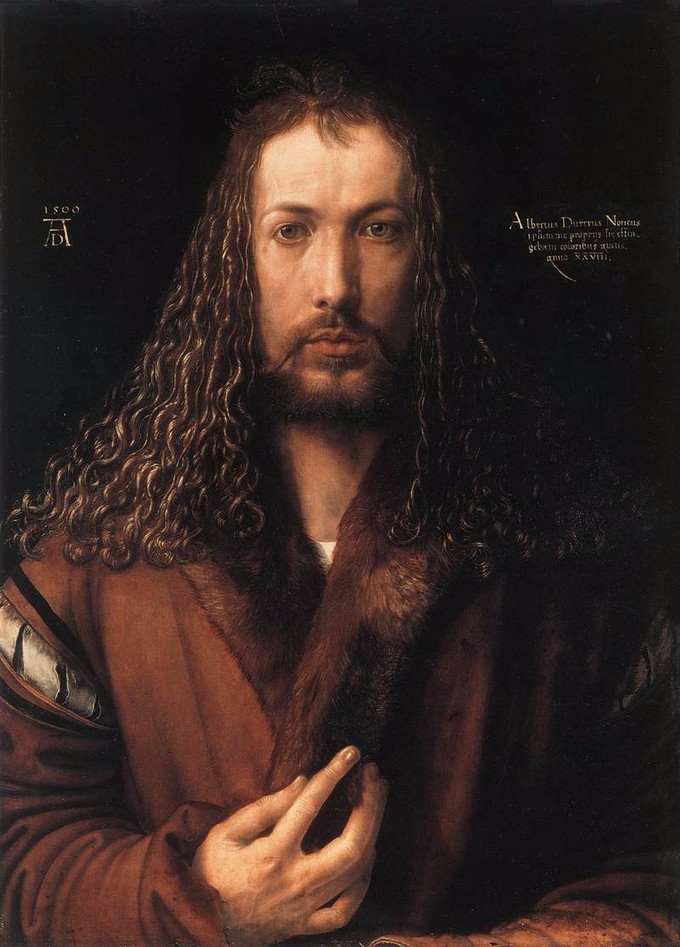
Albrecht Durer, Cocky Portrait, 1500.: This cocky portrait of Albrecht Durer was painted on a wood console, equally the canvas had yet to get the prevalent medium of choice.
High german Painting in the Northern Renaissance
The German language Renaissance is reflective of Italian and German influence in its paintings, and one is not present without the other.
Learning Objectives
Discuss the work of Dürer, Grünewald, Holbein, Altdorfer, and other artists of the Danube school during the Holy Roman Empire in Germany
Fundamental Takeaways
Fundamental Points
- Albrecht Dürer 's piece of work shows strong classical influence due, in office, to his travels to the Italian peninsula.
- Matthias Grünewald combined Gothic and Renaissance attributes in his painted work on the Isenheim Altarpiece .
- The Danube School is known for the first productions of painted landscapes (independent of foreground figures) in almost 1,000 years.
- Hans Holbein the Elder and his brother Sigismund Holbein painted religious works in the late Gothic style . The one-time was a pioneer and leader in the transformation of German language art from the Gothic to the Renaissance style.
- The outstanding achievements of the first half of the 16th century were followed by a remarkable absenteeism of noteworthy German art.
Key Terms
- perspective: The illusion of distance or depth on a 2-dimensional surface.
- en plein air: In an outdoor setting, every bit opposed to in a studio or other interior location.
- polyptych: An artwork, usually a painting, consisting of 4 or more than panels.
- Classical ornament: Influenced by the Roman motif in style.
Albrecht Dürer
1 of a small number of Germans with the means to travel internationally, Nuremberg built-in Albrecht Dürer (1471–1528) helped bring the artistic styles of the Renaissance north of the Italian Alps after his visits to the Italian peninsula in the late 15th and early 16th centuries. Similar the Italian artists Leonardo da Vinci and Michelangelo Buonarotti, Dürer was a Renaissance Human being, adept in multiple disciplines such as painting, printmaking , and mathematical theorizing. Dürer's introduction of classical motifs into Northern fine art has secured his reputation as 1 of the near important figures of the Northern Renaissance . This is reinforced past his theoretical treatises, which involve principles of mathematics, perspective , and platonic proportions.
One of Dürer'due south paintings that display a clearly classical rendering of the torso is Adam and Eve (1507), the beginning total-scale nude subjects in High german painting. A clear departure from apartment and stylized representations of the Romanesque and Gothic periods, the bodies appear naturalistic and dynamic, with each figure posed in an engaging contrapposto pose. Although they stand against a black background, the footing on which both figures stand and the tree that flanks Eve comprise naturalistic landscape elements. Likely the first mural painter in Early Modern Europe, Dürer honed his landscape painting skills working en plein air at home and during his travels.

Albrecht Dürer, Adam and Eve : Oil on panel. 1507. 2 panels, each 209 cm × 81 cm (82 in × 32 in) Museo del Prado, Madrid.
Matthias Grünewald
Lying somewhat exterior these developments is Matthias Grünewald, whose birthplace is located in eastern France and who left very few works. However, his Isenheim Altarpiece (1512–1516), produced in collaboration with Niclaus of Haguenau, has been widely regarded as the greatest German Renaissance painting since it was restored to disquisitional attending in the 19th century. It is an intensely emotional work that continues the German Gothic tradition of unrestrained gesture and expression, using Renaissance compositional principles while maintaining the Gothic format of the multi-winged polyptych .

Matthias Grünewald, Isenheim Altarpiece (closed): Oil on panel (outside). Wooden relief sculptures (interior). 1512–16. Unterlinden Museum, Colmar, Alsace.
In its closed form , the Isenheim Altarpiece depicts an emaciated Christ whose pare bears many dark spots. Its lower panel, which houses relief sculptures displayed on certain feast days, opens in a mode that makes the legs of Christ, being entombed, appear amputated. Not surprisingly, Grünewald produced the altarpiece for a chapel in an hospital that treated patients with a variety of diseases, including ergotism and isolated remaining strains of the plague. A chief symptom of both diseases was painful sores on the skin. In some cases of ergotism, limbs adult gangrene and had to be amputated. Through the skin sores and seemingly amputated legs, Grünewald informs the viewer that Christ understands and feels the suffering of the sick. Such "humanization" of Biblical figures became common throughout Europe during the Renaissance in an endeavour to brand them more relatable to worshippers.
The Danube School
Albrecht Altdorfer's (c.1480–1538) Danube Landscape near Regensburg (c. 1528) is one of the earliest Western pure landscapes. The Danube School is the name of a circumvolve of artists from the southern German-speaking states active during the first third of the 16th century in Bavaria and Austria, including Albrecht Altdorfer, Wolf Huber, and Augustin Hirschvogel. With Altdorfer in the pb, the school produced the first examples of independent mural art in the West (well-nigh one,000 years after China), in both paintings and prints. Their religious paintings had an expressionist style somewhat similar to Grünewald'southward. Dürer's pupils Hans Burgkmair and Hans Baldung Grien worked largely in prints, with Baldung developing the topical bailiwick matter of witches in a number of enigmatic prints.

Albrecht Altdorfer (c.1480–1538), Danube mural well-nigh Regensburg (c. 1528): 1 of the earliest Western pure landscapes, from the Danube School in southern Frg.
Hans Holbein the Elder
Hans Holbein the Elder and his brother Sigismund Holbein painted richly colored religious works. His later paintings show how he pioneered and led the transformation of German fine art from the (Late) International Gothic to the Renaissance fashion. Holbein the Elder was a pioneer and leader in the transformation of German art from the Gothic to the Renaissance style. His son, Hans Holbein the Younger, was an important painter of portraits and a few religious works, working mainly in England and Switzerland.

Hans Holbein the Elder, Dormition of the Virgin: Oil on panel. c. 1491. Museum of Fine Arts, Budapest.
The outstanding achievements of the kickoff half of the 16th century were followed by a remarkable absence of noteworthy High german art. The next significant High german artists worked in the rather artificial fashion of Northern Mannerism , which they had to larn in Italia or Flanders . Hans von Aachen and the Netherlandish Bartholomeus Spranger were the leading painters at the Imperial courts in Vienna and Prague, and the productive Netherlandish Sadeler family unit of engravers spread out across Frg, among other counties.
Spanish Painting in the Northern Renaissance
Spanish art of the Northern Renaissance was influenced by Netherlandish painting, due to shared economic and political connections.
Learning Objectives
Hash out the Golden Age of Spain every bit manifested through painting
Primal Takeaways
Cardinal Points
- Spain was an extremely devout country and Spanish painting in the 16th century exhibited a sense of religious intensity .
- El Greco was one of the near important and distinctive artists to emerge during the Spanish Golden Age.
- Mannerism was the ascendant way of painting for most of the 16th century.
Key Terms
- intensity: The degree of depth, strength, or brilliance of a color or low-cal.
- sfumato: In painting, the application of subtle layers of translucent paint so that in that location is no visible transition between colors, tones, and often objects.
- Mannerism: A style of art developed at the end of the High Renaissance, characterized past the deliberate distortion and exaggeration of perspective, peculiarly the elongation of figures.
Influence of the Netherlands
Due to important economic and political links between Spain and the Netherlands (which included present-day Holland and Belgium) from the mid-15th century onwards, the early Renaissance in Espana was heavily influenced by Netherlandish painting, leading to the identification of a Hispano-Netherlandish schoolhouse of painters. Overall the Renaissance and subsequent Mannerist styles are hard to categorize in Spain, due to the mix of Netherlandish and Italian influences, and regional variations.
Autonomously from technical aspects, the themes and spirit of the Renaissance were modified to the Castilian culture and religious environment. Consequently, very few classical subjects or female nudes were depicted. Rather, the works frequently exhibited a sense of pious devotion and religious intensity—attributes that would remain dominant in much art of Counter Reformation Kingdom of spain throughout the 17th century and beyond.
Spanish Gilt Age
The Castilian Aureate Age, a flow of Spanish political clout and subsequent refuse, saw a keen development of fine art in Spain. The menstruum is generally considered to have begun at some bespeak afterwards 1492 and ended by or with the Treaty of the Pyrenees in 1659; in fine art the start is delayed until the reign of Philip III (1598–1621) or just earlier, and the terminate is as well delayed until the 1660s or later.
Luis de Morales
The most popular Castilian painter of the early 16th century was Luis de Morales (c. 1510–1586), called "The Divine" by his contemporaries, considering of the religious intensity of his paintings. From the Renaissance style, he also frequently used sfumato modeling, and elementary compositions only combined them with Netherlandish mode precision of details. His subjects included many devotional images, including the Madonna and Child.

Luis de Morales, Madonna and Child : Oil on canvas. 1586. Museo del Prado, Madrid.
El Greco
Doménikos Theotokópoulos, better known equally El Greco (1541–1614) "the Greek," was one of the most individualistic of the painters of the period, developing a strongly Mannerist way based on his origins in the mail service-Byzantine Cretan school, in contrast to the naturalistic approaches and then predominant in Seville, Madrid, and elsewhere in Spain.

Portrait of a Man by El Greco, 1604: This is presumably a self-portrait by the cracking Spanish Mannerist.
Universally known for his bang-up impact in bringing the Italian Renaissance to Spain, El Greco studied the great Italian masters of his time—Titian, Tintoretto, and Michelangelo—when he lived in Italy from 1568 to 1577. Many of his works reflect the silvery grays and strong colors of Venetian painters such as Titian, while adding strange elongations of figures, unusual lighting, disposing of perspective space , and filling the surface with very visible and expressive brushwork. Although his signature style would eventually become renowned and influence after artists, during his lifetime, El Greco received harsh criticism in his native Crete and his adopted country of Kingdom of spain for not befitting to stylistic norms.
In 1577, El Greco relocated to Kingdom of spain, where he produced his mature works. His mature style is characterized by a tendency to dramatize rather than to describe. The strong spiritual emotion transfers from painting direct to the audience. El Greco'southward preference for exceptionally alpine and slender figures and elongated compositions, which served both his expressive purposes and artful principles, led him to disregard the laws of nature and elongate his compositions to ever greater extents, particularly when they were destined for altarpieces .

The Disrobing of Christ (El Espolio) past El Greco, 1577–79: Oil on canvas. Sacristy of the Cathedral, Toledo. This is one of the near famous altarpieces by El Greco. His altarpieces are renowned for their dynamic compositions and startling innovations.
A meaning innovation of El Greco'southward mature works is the interweaving between form and space. A reciprocal human relationship is adult between the two that completely unifies the painting surface. This interweaving would re-emerge 3 centuries later on in the works of Paul Cézanne and Pablo Picasso .
El Greco'south most famous painting, The Burial of the Count of Orgaz (1586–88) blends his signature style with the classical revival of the Renaissance and medieval renderings of the torso. The lower register represents the earthly plane in which mourners gather for the count's burial. The count, the mourners, and virtually of the clergy are rendered in a mode that acknowledge the body beneath the wear. However, the ii loftier-ranking clergy members burial the body, too as the 1 reading the sermon on the right, wear bulky garments that practice not acknowledge the torso, as figures were oft depicted in the Centre Ages . On the upper register, Christ, the Virgin Mary, and a host of members of the heavenly court gather to welcome the count'south soul (the kneeling semi-naked human in a loincloth) to heaven. In this other worldy delineation, El Greco has elongated the bodies and filled negative spaces with sweeping, expressive lines and forms to create a sense of drama.

The Burial of the Count of Orgaz by El Greco: Now El Greco'south best known piece of work, this painting illustrates a popular local fable. Information technology is clearly divided into two zones: the heavenly above and the terrestrial below, brought together compositionally.
English Painting in the Northern Renaissance
The Tudor period was, for England, one of isolation from European trends.
Learning Objectives
Hash out the paintings produced under the Tudor dynasty in England
Key Takeaways
Primal Points
- In the Tudor menstruum, foreign artists were recruited and often welcomed lavishly by the English court.
- The Netherlandish painters remained predominant, though French influence was also of import for Lucas Horenbout and Nicholas Hilliard. Despite a growing influence of classicism on the continent, Horenbout's early on miniatures of the regal family unit testify a strong influence of illuminated manuscript styles .
- The German language artist Hans Holbein the Younger was probably the all-time known painter of the court of Henry 8. His double portrait The Ambassadors foreshadows the increasingly secular subject field matter of English language painting.
- With the virtual extinction of religious painting during the Reformation , and little interest in classical mythology until the very end of the menstruum, the portrait was the most of import grade of painting for all the artists of the Tudor court, and the but one to accept survived in any numbers.
- A portrait of Elizabeth I equally a princess is largely absent of religious symbolism despite its sitter's future function equally Defender of the Organized religion. Although the manner of the portrait bears striking similarities to contemporary purple portraits produced in France, the sitter's status equally a female person future sovereign was unique for its time.
Key Terms
- limner: A painter who specializes in the product of portrait miniatures.
- Tudors: A European royal house of Welsh origin that ruled the Kingdom of England and its realms, including the Lordship of Ireland (later the Kingdom of Ireland) from 1485 until 1603.
Art of the Tudor Courtroom
The artists of the Tudor courtroom were the painters and limners engaged by the English language monarchs' Tudor dynasty and their courtiers between 1485 and 1603 (from the reign of Henry VII to the expiry of Elizabeth I). Typically managing a grouping of assistants and apprentices in a workshop or studio, many of these artists produced works across several disciplines, including portrait miniatures, large-scale panel portraits on woods, and illuminated manuscripts.
The Tudor period was, for England, one of unusual isolation from European trends. At the start, the Wars of the Roses had greatly disrupted artistic action, which apart from architecture had reached a very low ebb by 1485. In the Tudor period, foreign artists were recruited and ofttimes welcomed lavishly by the English court, as they were in other artistically marginal parts of Europe like Spain or Naples. The Netherlandish painters remained predominant, though French influence was also important for both Lucas Horenbout, trained in illuminated manuscripts, and Nicholas Hilliard, the founder and greatest exponent of the distinctively English tradition of the portrait miniature. Horenbout's portrait miniature of Katharine of Aragon, the showtime wife of Henry VIII, with its relatively flat subject thing and gold outlines , bears a closer resemblance to illuminated manuscripts than to the realistically modeled classical manner appearing elsewhere in Europe at the time.

Katharine of Aragon with a Monkey past Lucas Horenbout, 1525–26. Miniature.
The Courtroom of Henry VIII
Possibly the best known painter employed in the courtroom of Henry VIII was the German language artist Hans Holbein the Younger (1497–1543), who worked in the fashion of the Northern Renaissance . His portraits of the regal family unit and nobles are a tape of the court in the years when the king was asserting his supremacy over the English church. By 1533, when Holbein painted his famous double portrait The Ambassadors, Henry Eight had severed the Church of England from Rome when the Pope refused to allow the king to divorce Katharine of Aragon and ally Anne Boelyn.

The Ambassadors by Hans Holbein the Younger, 1533: Oil on panel. National Gallery, London.
Although Holbein'south sitters Jean de Dinteville and Georges de Selve were ordained Catholic priests from France, religious symbolism in the painting is significantly subordinated. Virtually subconscious behind the green curtain in the upper left-manus corner is a crucifix. On the 2d level of the table between the ambassadors is a lute (typically a symbol of harmony) with a broken string, symbolizing the separation of the English church from Roman Catholicism. The book in front end of it provides an explanation for the discord, equally information technology is opened to a hymn to Martin Luther, who began the Protestant Reformation . Unlike Holbein's native land, in which Lutheranism permitted a certain caste of religious imagery , the discipline matter in The Ambassadors foreshadows the new direction in religious austerity in English art equally Catholicism became less tolerated.
The Court of Elizabeth I
With the virtual extinction of religious painting during the Reformation and footling interest in classical mythology until the very end of the period, the portrait was the nearly important form of painting for all the artists of the Tudor courtroom, and the only form to have survived in any numbers. How many of these take also been lost can be seen from Holbein's book (nearly all pages in the Regal Collection), containing preparatory drawings for portraits. Of 85 drawings, but a scattering accept surviving Holbein paintings, though often copies have survived. Portraiture ranged from the informal miniature—almost invariably painted from life in the course of a few days and intended for individual contemplation—to the later large-scale portraits of Elizabeth I, such as the Rainbow Portrait, filled with symbolic iconography in wearing apparel, jewels, background, and inscription.

The Rainbow Portrait past Isaac Oliver c. 1600.: This portrait of Elizabeth I equally the "Queen of Honey and Beauty" epitomizes the elaborate iconography associated with later on Tudor courtroom portraiture.
Elizabeth I took a personal interest in painting, keeping her own collection of miniatures locked away, wrapped in newspaper on which she wrote the names of the sitter. She is reputed to have had paintings of her burnt that did not match the iconic epitome she wished to be shown. One portrait that she did retain was painted earlier she ascended the throne. Elizabeth I as Princess (c. 1546), one time attributed to William Scrots but now believed to accept been painted by Levinia Teerlinc, depicts a young literate woman standing erect and exchanging her gaze with the viewer in the confident manner in which Jean Clouet painted François I of France. Whereas Holbein subordinates the crucifix in The Ambassadors, the but hint at religious symbolism in this portrait of the future Defender of the Organized religion are the abstract cruciform designs on her brooch and her chugalug. The book in her hand and on the easel behind her acquit no title or writing, allowing them to be interpreted equally secular literature, as opposed to Biblical scripture.

Elizabeth I as Princess past Levinia Teerlinc [?], c. 1546: Oil on console. Imperial Drove, Windsor Castle.
While the portrait manner of the classically rendered confident sitter against a decorative background shows French influence, the gender of the sitter was unique to England at the time. Because Henry Viii'due south only surviving son had died during his boyhood, the English language police force of succession had to be amended to let Elizabeth and her elder sis Mary admission to the throne. Later portraits of Elizabeth would often describe her holding a globe in her hand to symbolize her growing international power in an age of exploration and conquest. In France, on the other hand, women were barred from serving as sovereign rulers and would never be pictured as possessing such power.
Source: https://courses.lumenlearning.com/boundless-arthistory/chapter/painting-in-the-northern-renaissance/
0 Response to "The Will Expand in the Art of Northern Europe Into the Fifteenth Century and Beyond"
Post a Comment